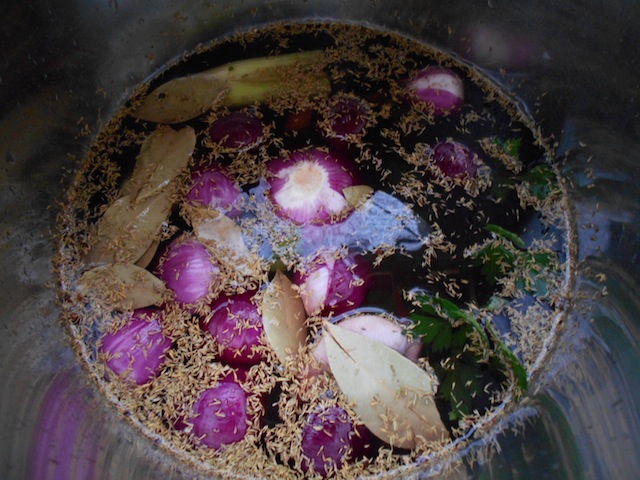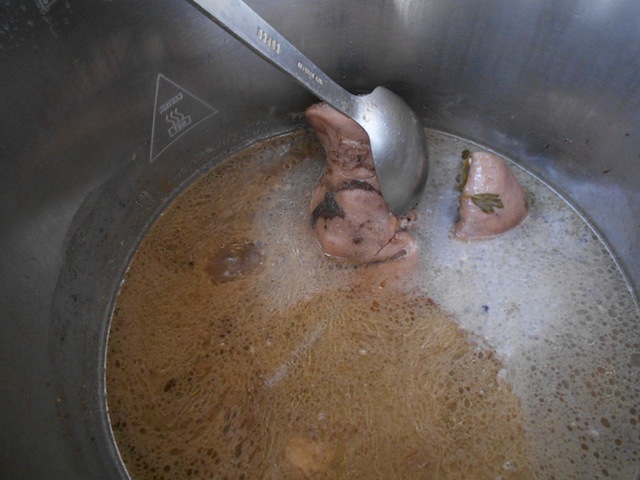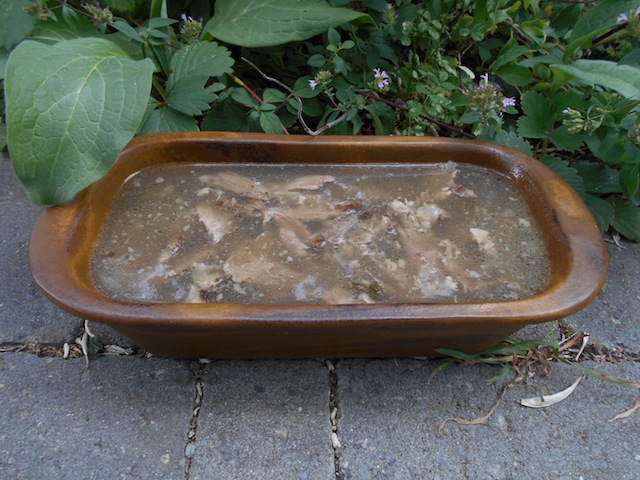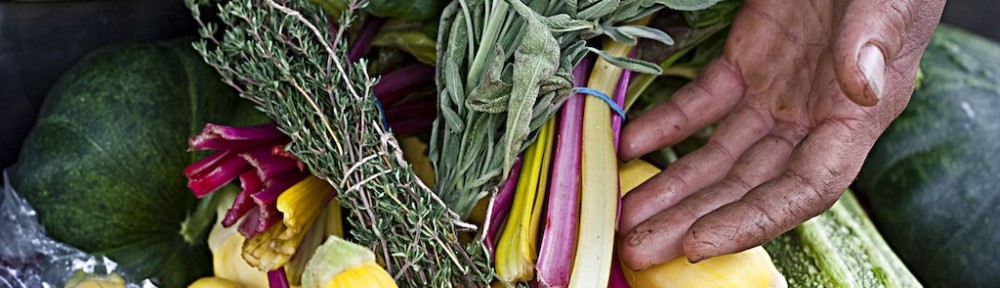
Here are some heritage purple potatoes from my sister.
GUEST POST by Shaen Cooper
Last fall before the snow came, I tried deep mulching using a layer of waste paper. I put the waste paper directly over the soil. In some areas, the paper was up to one inch thick. Then I covered the waste paper with a deep layer of mulch. I used tree chips and grass clippings — both waste materials from neighbors. In some areas, I used old, moldy straw and hay. The top mulch was six to twelve inches deep. During the winter, the soil was insulated by the paper and mulch. There appeared to be more bacterial action in the soil.
In the spring, I found the layer of paper well on its way to decomposing. Under the layer of paper, the soil was moist to the touch. Normally, the soil would be very dry after the winter and would require heavy watering.
You can see the layer of paper after the winter is well on the way to decomposing but is still acting as a protective layer to the soil.
When choosing mulch, use waste materials that you have on hand or reuse a waste material of neighbors. Waste hay always has lots of grass seed. Use waste hay to mulch areas you want grass to grow.
When I break through the paper layer the soil is damp and ready for planting.
I made the hole large enough to get my hand in. The paper layer will stop weeds until the potato can get going.
Every spring, I clean up the raspberry brushes and take out the old canes. These canes are good for trellising or marking individual plants. Deep mulching is good for:
disposal of waste household or office paper
keeping the soil moist and fertile
physical barrier to weed growth
I like using canes as a marker for new plants. This helps me know where to hand water while the plant is getting going.
Updated May 21, 2013: Please note that drought and ground water depletion and contamination are becoming the issue of our time. With our government selling rights for fracking, safe ground water may soon be a thing of the past. Many aspects of permaculture will be helpful in drought situations. Here are some steps we can take to help stop drought:
Keep soil temperature as low as possible by deep mulching.
Increase organic material so when the rains come the water will stay on the land.
Fight soil compaction — which repels water — by encouraging soil flora and fauna.
Use drip irrigation and greywater systems.
Plant forest gardens to provide habitat for wild animals while producing food for humans.
Plant drought resistance grasses, forbs and weeds.
Reduce pressure on land by using intensive grazing rotation plan.
Build ponds or use mobile ponds.
Use mobile shade for livestock to encourage manuring in shaded areas.
Here is an Agriculture and Agri-Food Canada map of accumulated precipitation.
“The common dandelion, enemy of well-kept lawns, is an exceptionally nutritious food. Its leaves and root contain substantial levels of vitamins A, C, D, and B complex as well as iron, magnesium, zinc, potassium, manganese, copper, choline, calcium, boron, and silicon.” Dandelion Leaf by Mountain Rose Herbs
Dandelion Green Chips are a wonderful spring snack. If this snack caught on it would improve everyone’s health while reducing lawn herbicide!
Are you looking for a non-toxic dandelion control? Eat your weeds and improve your health at the same time!
This winter I discovered Kale Chips. Kale Chips have become my favorite snack food. I couldn’t seem to get enough. As the winter progressed my husband started complaining about the cost of organic kale.
My husband has since planted kale in the garden and will try to overwinter the plants to satisfy my winter comfort food. While in the garden, I was looking at the tiny kale plants and wondering when I could have my first snack. A bright yellow flower caught my eye and said: “Why not Dandelion Green Chips?” It’s times like this that I realize I am walking through my days only half awake.
6-8c garden dandelion greens, remove stem end
1-3T organic extra virgin olive oil
1/2tsp sea salt, ground
pinch of bird’s eye chili or other hot chili, ground
I got a large bowl and started pulling out leaves. I filled the bowl and returned to the kitchen. I removed the stem ends. I tossed the dandelion greens with some extra-virgin olive oil, sea salt and a very small amount of bird’s eye chili. I thought the chili might counter-act the bitterness of the dandelion greens. I cooked the dandelion greens at 300°F for about 10-15 minutes.
About 50% of the people in the household loved the Dandelion Green Chips and the other 50% found the chips too bitter. Of course, I have been eating kale all winter so the dandelion didn’t taste bitter to me. Give the recipe a try and tell me what you think.
Growing your own food is a very liberating experience. Start your own urban homestead and be healed by real food.
In our society, growing food yourself has become the most radical of acts. It is truly the only effective protest, one that can – and will – overturn the corporate powers that be. By the process of directly working in harmony with nature, we do the one thing most essential to change the would – we change ourselves. Jules Dervaes
This post is an index of all the gardening and farming experiences we have had over the last few years. During our time in Kamloops we have greatly increased our knowledge about permaculture, forest gardens, and pasturing. We have learned how to slaughter and process meat and fowl. We have learned about secondary food processing. I have watched my health, and the health of my family, get better. Good food is a real healer.
We have become aware that food is a political issue. Just talking about food becomes a political discussion very quickly. Unlike Jules Dervaes, I am more concerned with government forces that create the regulations, rather than corporate forces that may be working in the background pulling stings. Governments have the power to create laws which control the courts. Government created laws are backed up by the use of force and imprisonment. Corporations might dream of having this kind of power but it’s only a dream. Corporate powers can lobby but the real power sits with government.
There are political decisions being made right now that are resulting in greater barriers for small scale farmers and ranchers to sell their products to the public. This means you will have greater difficulties finding local food. These problems seem to be intensifying right now, or maybe I am just becoming aware of what has been going on for a very long time.
Producing our own food has been a fascinating journey. I hope that sharing our experiences will encourage others to grow their own urban homestead. Doing so will increase food security for everyone. I hope these stories will also help people who are disconnected from their food supply to appreciate the work that goes into producing quality food.
“In my household we produce much of our own food and try to do without as many frivolous “necessities” as possible — and yet, like everyone else, we must shop, and when we shop we must bring home a load of plastic, aluminum, and glass containers designed to be thrown away, and ‘appliances’ designed to wear out quickly and be thrown away.” What Matters? Economics for a Renewed Commonwealth by Wendall Berry
In spring, I seem to be particularly sensitive to the effects of garbage. I have been picking garbage around my home in the Ironmask Industrial Park. I know an industrial park is a strange place to raise a family — but providence has brought me here — and I will take care of the land that I am given.
There appears to be a long history of dumping in Kamloops. I have found numerous dumping spots all around Kamloops. Kamloops being such a dry place means garbage lasts a long time. Metal doesn’t rust very quickly, nor does wood decompose with any vigor, while bones and plastics are bleached white in the sun. I would like to take you on a short walk into the Tragedy of the Commons that is taking place in the Crown Forest Lands behind my home.
There is nothing like taking an early morning walk in the tranquility of the countryside. Unfortunately, this walk is not as pleasant as it could be.
“I confess that I am angry at the manufacturers who make these things. There are days when I would be delighted if certain corporation executives could somehow be obliged to eat their products. I know of no good reason why these containers and all other forms of manufactured “waste” — solid, liquid, toxic, or whatever — should not be outlawed.”
This old camper was set on fire and partly destroyed. Only the metal framework remains but it has the look of something that has been around a long time.
These sand bags were dumped last week into the middle of the road. I wonder if the next vehicle to pass by will bottom-out on the bags.
“Much of our waste problem is to be accounted for by the intentional flimsiness and unrepairability of the labor-savers and gadgets that we have become addicted to… We have made a social ideal of minimal involvement in the growing and cooking of food. This is one of the dearest ‘liberations’ of our affluence.”
I wonder if this large screened television was once someone’s pride-and-joy. Now it stands sentry as a burnt out wreck in the forest.
“But our waste problem is not the fault only of producers. It is the fault of an economy that is wasteful from top to bottom — a symbiosis of an unlimited greed at the top and a lazy, passive, and self-indulgent consumptiveness at the bottom — and all of us are involved in it.”
What is the story behind this engine block? Shaen wondered why the person dumped this piece of metal in the forest when scrap metal yards will pay money for steel.
“The mess that surrounds us, then, must be understood not just as a problem in itself but as a symptom of a greater and graver problem: the centralization of our economy, the gathering of the productive property and power into fewer and fewer hands, and the consequent destruction, everywhere, of the local economies of household, neighborhood, and community.”
This poor beast with its broken leg just appeared a few days ago. I have no idea how it found itself dumped in with the garbage. Someone came along and tried to burn it but the job was only partly done. Someone is in the woods trying to clean-up this mess but this person can’t seem to keep ahead of the dumping.
“The ecological damage of centralization and waste is thus inextricably involved with human damage. For we have, as a result, not only a desecrated, ugly, and dangerous country in which to live until we are in some manner poisoned by it, and a constant and now generally accepted problem of unemployed and unemployable workers, but also classrooms full of children who lack the experience and discipline of fundamental human tasks, and various institutions full of still capable old people who are useless and lonely.”
Discarding Christmas trees in the forest makes a lot of good sense because they will decompose over time and make soil. These sad Christmas trees — which I see everywhere — have become a symbol for me of holiday excess and our throw-away culture.
“I think that we must learn to see the trash on our streets and roadsides, in our rivers, and in our woods and fields, not as the side effect of ‘more jobs’ as its manufacturers invariably insist that it is, but as evidence of good work not done by people able to do it.”
I don’t know why there is such a long tradition of dumping in Kamloops. I try to understand why they dump by looking at the garbage and wondering about its story. If someone has a vehicle, why go into the forest to dump when there is the Kamloops Landfill and free recycling in the city?
I want more freedoms for us all. But here in the forest where it’s free, I see sad evidence. Governments point to such behavior and justify taking away everyone’s freedom because a few people act in less than enlightened ways. I don’t have any solutions other than picking up the mistakes of others. I just wanted to share with you what is happening in the forest lands near my home.
There are some isolated giant Douglas Firs in the forest lands around Kamloops. These isolated trees give us a window into the past. I can almost see the vast grasslands, interspersed by these great trees.
Updated May 4, 2013: Garbage is unsightly, but a more serious Tragedy of the Commons is happening in BC regarding water and fracking.
Last week I was talking with Todd Stone, Kamloops South candidate for the BC Liberals, about his government’s policy to promotion fracking. He says fracking has a forty year history in BC and is totally safe due to government regulations. He told me the problems with fracking can’t happen here in Canada because Canada has the best regulations in the world. I contacted Big Bear Ranch for evidence about fracking damage in Canada.
These two videos are about Jessica Ernst from Rosebud, AB. Jessica Ernst worked for the last thirty year in the Oil and Gas Industry as a Environmental Scientist. The first video is a six minute introduction. The second video is the documentation of the contamination that occurred in Rosebud, AB. Presently, Jessica Ernst is suing EnCana Corporation and the Alberta Government for water contamination. If you want your children to be able to drink clean water please watch both videos.
Updated May 7, 2013: I have just watched a National Film Board documentary called Wiebo’s War. You can watch it online for just a few dollars. Here is more information about the film: “Wiebo’s War is a feature documentary that tells the story of a man’s epic battle with the oil and gas industry. In the 1990s, natural gas wells were drilled near the home of Reverend Wiebo Ludwig and his clan in Alberta. Soon after, livestock began to die, and the Christian community started experiencing health problems, including a series of miscarriages. After 5 years of being ignored by the oil and gas industry, Ludwig decided to fight for his land and his family’s survival.”
Updated May 9, 2013: I just had to post this pile of shotgun shells. I couldn’t believe the size. It’s piled two feet high, with a diameter of five feet. I could tell that someone was cleaning up the mess.
This morning I met David. He lives up at Lac Le Jeune, BC and comes here every day for a walk and to pick-up garbage. David said that the Thompson Nicola Highway Department will come around and pick-up the pile of garbage. Seeing David’s commitment to the forest makes me want to bring a garbage bag on tomorrow’s walk too.
David is Goose Lake Road’s “forest guardian”. He comes here every day and picks-up garbage.
I found the book very concise and easy to use. Linda outlines a very simple system for gardeners to start using Integrated Pest Management which includes: prevention, identification, observation, treatment (or no treatment), and follow-up. But most of all, she gives the sage advice: “Don’t panic!” Many times, Linda suggests, “It’s best to just observe the problem and do nothing.” She counsels gardeners to avoid “revenge spraying” stating that the population explosion of the pest has probably already resolved itself. Linda suggests the best medicine is prevention:
Start with healthy plants. If there is a local disease, choose a resistant variety.
Avoid stressing plants. Choose the right environment and manage appropriate rates of growth.
Use physical and mechanical barriers. Protect your crop from pests, weeds and diseases.
If you get a change to hear Linda lecture, I would highly recommend the experience. (Here is Linda’s Speaking Schedule.) Linda is a fantastic speaker and very funny. I never thought pest management could be so much fun!
West Coast Gardening: Natural Insect, Weed and Disease Control by Dr Linda Gilkeson.
Kamloops Master Gardeners will be offering their Basic Training Program starting September 7 to December 7, 2013. This course is only offered every second year, so if you are interested please call 250.372.0717.